Cultivar-specific responses of rice to changing environmental conditions
Japonica and indica rice met very different light environments on the way here. We ask what that means for growth, senescence and heading when the light changes again.
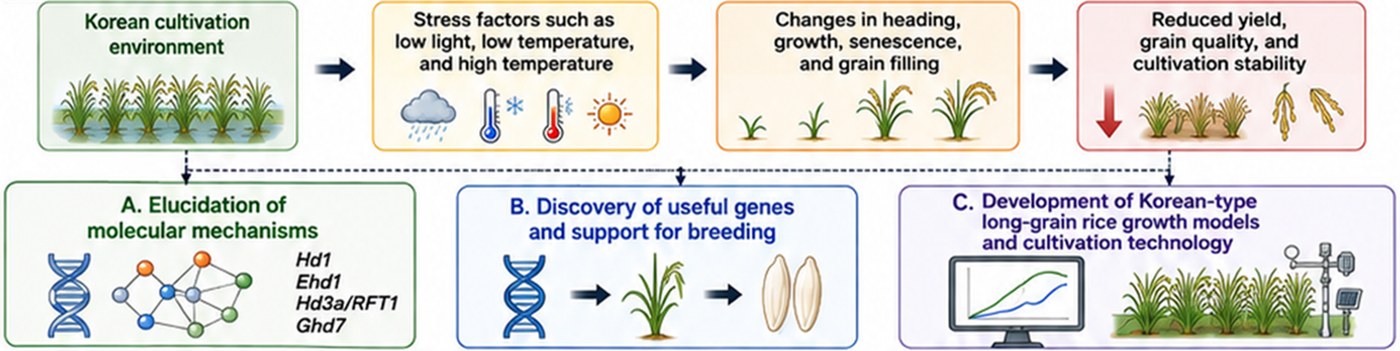
Rapid climate change and shifting cultivation environments pose growing challenges to stable rice production, highlighting the importance of understanding cultivar-specific growth and physiological responses under diverse environmental conditions. In particular, japonica rice, which is predominantly cultivated in Korea, and indica rice, which has adapted mainly to tropical and subtropical regions, may exhibit distinct responses to changes in the light environment.
Our research investigates cultivar-specific differences in rice growth, tillering, chlorophyll content, leaf senescence, and heading characteristics under various environmental conditions. We also analyze the expression of genes involved in photosynthesis, carbon metabolism, circadian regulation, and flowering-time control to elucidate the molecular mechanisms underlying these phenotypic differences.
Ultimately, our goal is to understand the distinct adaptive strategies of japonica and indica rice in response to changing light environments and to provide fundamental knowledge that can contribute to the development of rice cultivars capable of maintaining stable growth and productivity under low-light conditions.