Genetic variation and stress responses in Korean Arabidopsis thaliana ecotypes
Korean Arabidopsis populations grew up under a climate and terrain all their own. We ask how that shows up in their stress responses — and which genes are behind it.
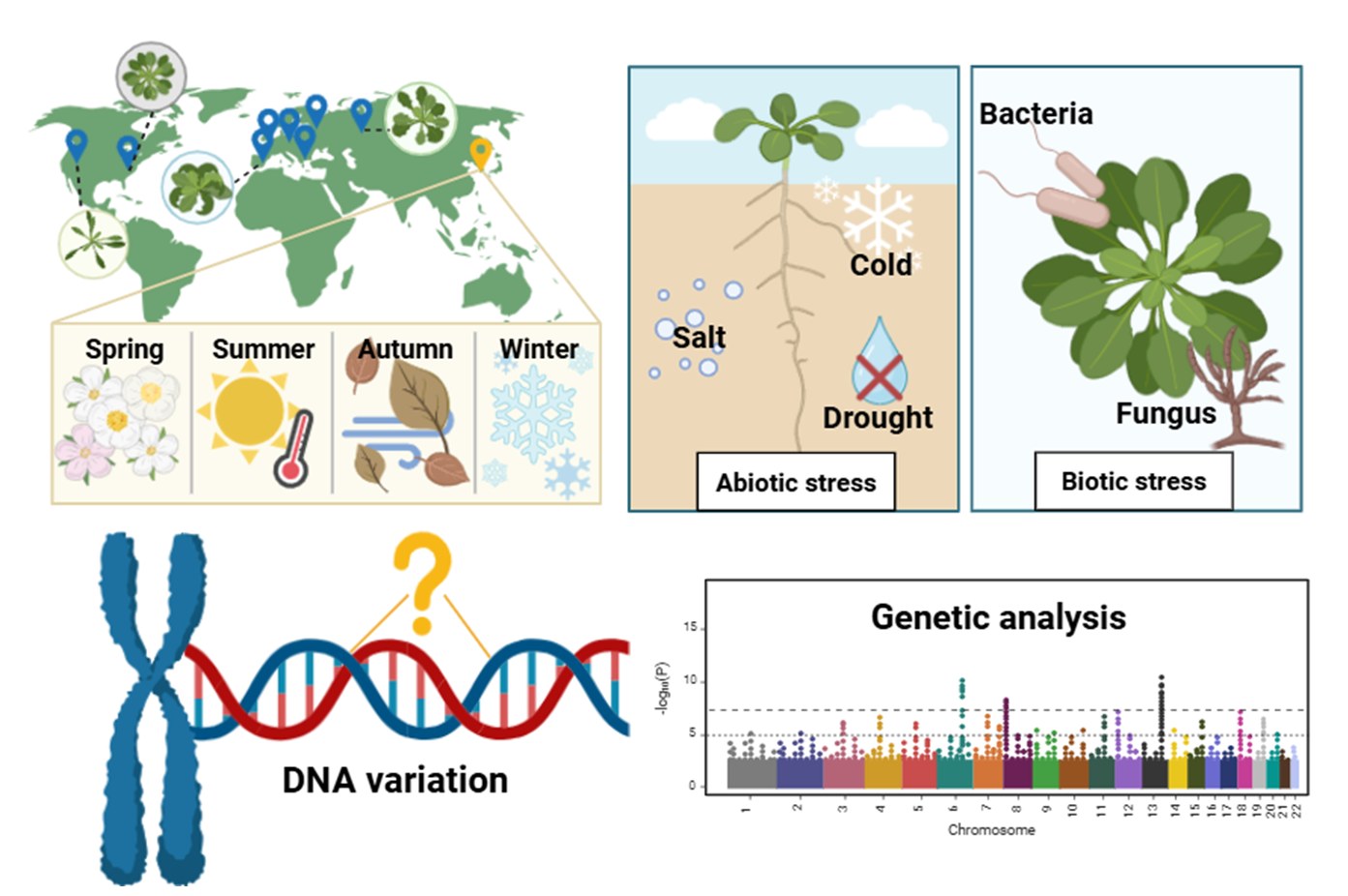
Plants, as sessile organisms, are continuously exposed to diverse environmental stresses, including drought, salinity, temperature fluctuations, and pathogen attack. These environmental pressures can promote morphological, physiological, and genetic variation within plant populations and may contribute to the formation of locally adapted ecotypes. An ecotype is a genetically differentiated population within a species that has adapted to specific environmental conditions.
Studies on natural variation and ecotypic differentiation in Arabidopsis thaliana have been extensively conducted in European and North American populations, whereas relatively limited attention has been given to Korean populations. The Korean Peninsula is characterized by considerable environmental heterogeneity due to its pronounced seasonal variation, and diverse topography including mountains and coastal regions. These geographic and climatic characteristics generate a wide range of local environmental conditions. Therefore, native plant populations in Korea may have evolved distinct stress-response strategies through adaptation to their local environments.
Arabidopsis thaliana is an excellent model system for investigating natural variation and environmental adaptation because of its short life cycle, small genome, extensive genomic resources, and high genetic stability within accessions. Phenotypic differences among Arabidopsis accessions may reflect underlying genetic variation, which can be investigated using approaches such as single nucleotide polymorphism (SNP) analysis and genome-wide association studies (GWAS). Identifying accessions with distinct stress-responsive phenotypes and comparing their genomic variation can therefore provide valuable insights into candidate genes and molecular mechanisms associated with environmental adaptation.
In this study, Korean Arabidopsis thaliana ecotypes are evaluated for phenotypic variation in response to both biotic and abiotic stresses. By integrating phenotypic, physiological, and genetic analyses, this study aims to elucidate the molecular and genetic basis of stress adaptation and ecotypic differentiation in Korean Arabidopsis populations.